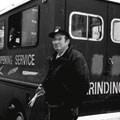
Charlie Zimmerman - WATER TANK BUILDER
New York Works: Audio Portraits of a Vanishing City
Produced by: Emily Botein & Joe Richman & Ben Shapiro The Next Big Thing (NPR) 2/9/2002


Dean Olsher, host:
Look up at the rooftops of New York and youíll see them. Giant structures that look like huge wooden barrels, and in fact thatís exactly what they are. Water tanks that make it possible for buildings taller than six stories to get decent water pressure. There are thousands of wooden tanks in the city and only a few companies left that build and re-build them. It takes a crew of six to eight men a whole day to take down an old tank and put up a new one so the tenants have water for their showers in the morning

HAMMERING SOUNDS

Charlie Zimmerman, water tank builder: Everything evolves around the water. Non one thinks about it as long as when 6they turn their faucet on they get water. But as soon as they turn their faucet on and they donít get no water then theyíre looking for us.

WORKERS TALKING TO EACH OTHER

Charlie Zimmerman: How Big the bottom is? Itís a normal bottomÖ 2 and three-eighths yeah. My name is Charles Zimmerman. I been working with Rosenwach Wood Tanks for approximately 22 years. And weíre at the 31 Union Square south working on a one-day job which consists of removing the old tank, taking it completely off the structure and installing a brand new ten by 12 wood tank. On a six ten story building. Any building over six floors in Manhattan has some sort of tank o nit. They have to have it because the city pressure will only go six stories. The beauty about a wood tank is it can be put in one day. It comes in pieces. You can transport it almost anywhere. Itís passed up the steel structure by hand. Everything is done by hand. It looks kind of ancient. But itís the only way to do it

HAMMERING

Charlie Zimmerman: Itís a grueling job. ItísÖ you got a get used to it. All of the time weíll get a new guy and sometimes the new guys donít make it half a day. They say, this is crazy, they donít like the work, and they canít handle the work. Course it can be potentially very dangerous. If you slip you could fall a long distance and you can get hurt pretty bad. You could fall anywhere from four feet to as tall as the building is in you fall one of the sides that are a the two sides that are on the edge of the building itís quite a ways down/.

CALLING TO EACH OTHER

Charlie Zimmerman: Done with the 2 and 1/2? Well you till need the 4!

Charlie Zimmerman: The higher up you get the more you see. But you'd be surprised how much stuff you can see down like 15, 16 stories. Look how many tanks you can see just from this roof here. And weíre only about 17 stories high. In view thereís got be 509 tanks. A wood tank forest, itís unbelievable.

Charlie Zimmerman: A lot of people look up and they see them. They know theyíre there but they donít know what they do. Youíll be stopped at a light and a personíll come up to you and say oh wow they still pout these things up, I thought they used ëem on the train stations. Yeah they think itís something from 2-300 years ago and now one ever took it down itís just laying up there. They think that you know they go up into a building and they turn the faucet on and no it somehow miraculously gets there. But thereís a lot that goes into bringing water into a high rise building.

HAMMER! Ö

Charlie Zimmerman: Now they have the whole bottom laid out now weíre going to start raising the stairs. The stairs to the outside of the tank. Big chunks of lumber. Heavy lumber cause itís yellow cedar. These stairs are twelve feet tall.

(I got it now)

Charlie Zimmerman: Weíre passing them hand over hand. We have three guys, one down down low, one guy in the middle and we have one guy up on top of the tank whoís passing em to another guy upon top. Heís the guy that's catching ëem?

HAMMERING

Charlie Zimmerman: Now you see how fast we go around the tank. Probably take maybe 45 min to and hour to raise the stairs. And once it all gets put together and we put the hoops on it and tighten it up. When the water gets inside the tank it leaks for about a day. And the water seals up the wood and thatís what stops the leaks. Itís like a wine barrel.

TALKINGÖ..WATER SOUNDS

Charlie Zimmerman: Weíre filling the tank. We just got the first bit of water going. When itís very hot ití a very tough job. You got the sun beating on you it gets so hot sometimes we canít even touch the tools. You got put a pair of gloves on to touch the tools. And the best part of putting a tank in the summer time when you turn that pump on for the first time. We rinse the tank out cause we have a lot of sawdust and things in it. When we do that first rinse, everybodyís underneath that pump line getting wet.

WATER POURING

Charlie Zimmerman: We actually swim around a little bit.

MUSIC IN

Charlie Zimmerman: Itís a pretty busy area the roofs of Manhattan. You know you look around you do it every day and every day you go up on the roof you always see something different that youíve never seen before. You see people having a picnic up there you see people eating their lunch up on the roof. You see them doing movies n the roof. Weíve had times when we were putting up a tank and they were making a commercial and the people stop with the commercial and come over and watch us. Anytime you see any kind of commercial anything that has to with anything do with a roof you'll always see one or two or three wood tanks on the roof there. People identify New York with these wood tanks. You know they see New York they see wood tanks. I know we do.

MUSIC OUT

© 2002 Emily Botein & Joe Richman & Ben Shapiro